
Few people enjoy writing so much that they do it just for fun. Sometimes an impulse or insight may inspire us to sit down and write "just for the heck of it," without any sense of readers or purpose. Poems and journals often start like that. If you've kept a journal, you know such writing can be enjoyable and worthwhile. You can explore your experience and sift it for meaning. Yet even such expressive writing springs from a real life context that elicits language. All writing is situation bound. It's a response prompted by various needs, desires, and demands from both inside and outside.
The better you understand the circumstances that prompt you to write, the better you can respond, adjusting your style to suit the specific context. The following figure may help you envision the writing context:
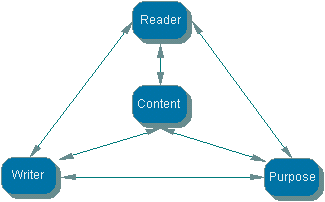
When you write, you may first look at the context from your own viewpoint. As you size up the situation, you begin to ask: Who is my reader? What purpose do I hope to achieve? What should I say in order to achieve my purpose?
The better you understand the circumstances that prompt you to write, the better you can respond, adjusting your style to suit the specific context.
You may note that your reader will be looking at the context from a different viewpoint. A reader might ask: What sort of person wrote this? What does the writer hope to accomplish? How has the content been shaped by the writer's experience and motives?
Responding well to the writing context requires seeing from multiple viewpoints, and seeing how these viewpoints interrelate. New questions appear: What sort of person will my reader perceive me to be? Will my reader understand and sympathize with my purpose in writing? What kinds and amounts of information does my reader require? How should I present this information in order to achieve my purpose? Consider the following example:
Writer: A college freshman away from home and working part-time at a fast-food restaurant to pay her expenses, a serious student majoring in pre-medicine but getting mentally and emotionally exhausted from the various pressures in her life.
Reader: Her parents, but especially her father who, she knows, will make the final decision after talking the issue out with her mother. Her father is a successful banker, generally loving and supportive but a bit old-fashioned in that he wants the daughter to get the kind of education that would fit her for a more conventional "woman's role" in society, maybe dental hygiene or nursing since she is interested in medicine. Her mother almost always remains subordinate to the father, but exerts a great deal of influence on the father and has at least hinted that she supports the girl's desire to become a doctor.
Purpose: To persuade her father to temporarily increase his level of financial support by a hundred dollars a month so that she can quit her job and concentrate more on her studies.
This is a tricky situation, but no more so than many others, once you analyze them closely. Thinking about the three points of our triangle, the girl begins to make decisions about the content of her message, what she wants to say and how she wants to say it. She wonders how to phrase the actual request for money and whether it should begin or end the letter. She wants to be sure to tell her parents the restaurant requires her to work every Thursday evening and she usually has an Organic Chemistry quiz on Friday morning. She wants to sound respectful, mature, and serious-not desperate or insistent. Very importantly, she wants to tell them that whatever they decide, she'll understand that they believe it to be in her best interest. She wonders whether she should speak of the money as a loan and offer to repay it the following summer. Finally, though, she decides against this, choosing to save it for a follow-up request if necessary.
You might be thinking you'd have approached the situation differently, omitting certain points and including others. If so, you're getting the idea of what it means to size-up the writing context.
Activity
3.1 Prepare a brief situation statement covering the four elements of the writing context: writer, reader, purpose, content. Imagine you are writing a letter asking someone to do a favor or help with a problem. If possible, choose a real person and a real problem. Use the following format:
SITUATION STATEMENT
Writer:
Reader:
Purpose:
Content: